

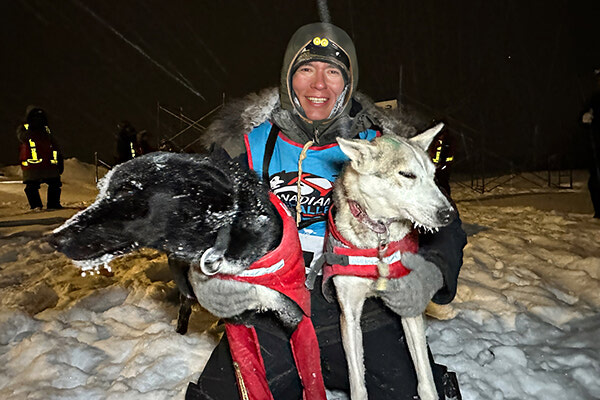
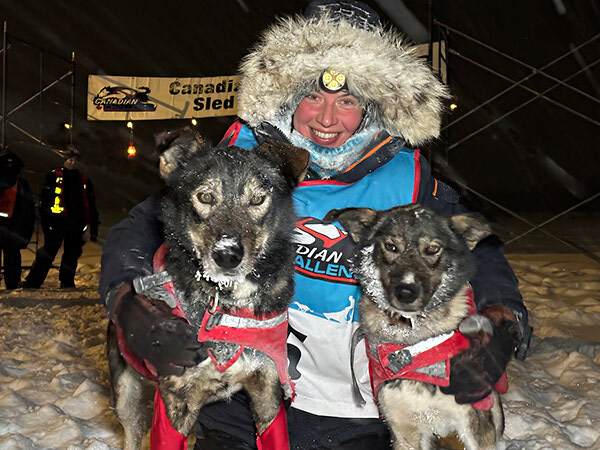
Jesse Terry competing in 1000-mile Iditarod sled dog race
Jesse Terry and Mary England finish 1st, 2nd in Canadian Challenge Sled Dog Race
Tim Brody - Editor
Sioux Lookout musher Jesse Terry is about to compete in the biggest race of his dogsledding career, the Iditarod.
On March 7, Terry and his dog team will make their way across the state of Alaska from Anchorage to Nome, 1000 miles through the wilderness.
“It’s been a long time I’ve had Iditarod in my mind,” said Terry, a proud member of Lac Seul First Nation. “To be honest, it was kind of a dream that I wasn’t sure was ever going to happen, just based on logistics of where we live, having a family, and also wondering if I would ever have a dog team that was capable of running it… I want to have a good dog team where I’m not just finishing, I kind of want to do well when I do something.”
For Terry, the race has been years in the making.
Terry has been involved with sled dogs since he was 11 and his father first brought home some sled dogs. He has been mushing for 30 years now. He and his wife Mary England, a fellow musher, run their own kennel, On The Land Sled Dogs.
He and his wife have been building their kennel and continuing their dogs’ training to the point where they feel they have the team that Terry has been hoping for.
Earlier this season Terry and England participated in the John Beargrease Sled Dog Marathon.
The race started on Jan 27 start in Billy’s Bar in Grand Portage, Minnesota.
Terry finished 3rd in 50 hours 41 minutes. England finished 9th in 58 hours 36 minutes
The 12-dog race spanned 300 miles.
“It was a very competitive race,” Terry shared.
“We were training all the dogs equally. There was no puppy team this year and the goal was to get all of the dogs with the same conditioning throughout the whole season,” Terry said. “Moving into the Beargrease we definitely had an A Team and B Team, with the goal of the A Team trying to be as competitive as possible but also manage the team in a way that preserves them for bigger things ahead in March. So, this idea of I want to race, but I’m not racing as hard as I could have because of the bigger goal at the end of the season. For Mary, it was a definite B Team and we’re really proud of that experience for Mary to come in 9th with our B Team basically in a very stacked team of racers.”
England commented, “Some difficult stretches in it. A lot of people scratched. It was quite cold and then heavy winds making some of the open areas difficult for travelling but the overall pool of mushers was large and very competitive.”
Next up for the couple on Feb. 17 was the Canadian Challenge Sled Dog Race, which began and concluded in La Ronge Saskatchewan.
Terry and England competed in the 200-mile event, but due to heavy snowfall, the distance was shortened to 160 miles.
Terry finished first in a time of 22 hours 41 minutes. England finished second in a time of 22 hours 46 minutes.
“What we choose to do with the Challenge was make the teams as equal as possible but also, for me, I wanted to put dogs in my team that I wasn’t sure if they were going to go to Iditarod or not. And so this idea of wanting to see them perform one more race myself, and these were dogs that were in Mary’s team, to see them perform to decide who goes to Iditarod, so I put some of those dogs in my team but also the goal was to make both teams as equal as possible to try and race the race together and going into it, the goal was first and second,” Terry explained.
“I feel like we could have raced harder. It wasn’t pedal to the metal per say, it was wanting to be competitive but also trying to preserve these dogs for a bigger event coming in March,” Terry said.
Terry and England switched back and forth leading the race. “So, we would switch and take turns up there and not just providing a rest for the leaders but also for the musher because the musher up front is working really hard to keep the pace and the musher behind can relax and oftentimes put the break on. Switching it up just really felt quite luxurious out there and was just really fun. We weren’t racing one another to beat one another during that time and then the very last leg with the time differentials, Jesse was able to leave about 10 minutes before me. Ten minutes in the last leg is a long time really and we didn’t want to risk having anybody else pass us in that time,” England explained.
She said of crossing the finish line first and second, husband and wife, representing their kennel, was very special, “It was pretty great. I think it speaks to the cohesiveness of our team and the collective training that we’ve done for those dogs, that they really are ready as a whole. It felt like we were two parts of the same team really, as we crossed the finish line one and two.”
“It was absolutely special,” Terry agreed. “It was one of the highlights of my mushing career to race that race with Mary and to be on the trail with her and on some of the most difficult legs we were running together and we swapped leads purposely to give the lead dogs a break from breaking trail because it snowed a ridiculous amount during the course of the race. At the checkpoints there was over 18 inches in 24 hours that came down. Being at the lead of the pack, you breaking trail, and essentially making it easier for every team that follows you.”
The coupled continued on from that race to Alaska for the Iditarod.
“It’s something I’ve never done before, racing 1000 miles,” Terry said.
“You’re training in smaller increments, doing 40, 50 mile runs consistently over and over again and that’s building up the dog’s conditioning and when they get to the 1000 mile race, they just have that collective conditioning enabling them to have a nice, gentle slow pace, lots of race, and they get into that rhythm,” England said of training for the race.
“In the Iditarod we move at a slower speed then we do in the mid-distance races,” Terry explained.
Terry will compete with a team of 16 dogs.
Terry shared, “It really seriously started coming together in the last couple of years where we were recognizing the dog team, performance-wise, they are capable of doing it really well and then also one of the big factors is that our kids are older and it’s easier to be away for the duration of time that we need to be away. Their mom, Seeka, is in a position where she’s able to be with the kids while we do this and we’d just like to send a really huge thank-you to her.”
Terry added, “Lots of encouragement from other mushers really kind of boosted me along as well. Many mushers just saying, “your dog team looks amazing! When are you going to Iditarod?” All of the races that we’re running are the stepping stones that people take to get to Iditarod. We’ve been doing those and doing those relatively well. This year felt like it was the right year to give it a go.”
“The winner generally does it in just under nine days… it varies from year to year depending on conditions of the trail. My goal is to do it in 11 days or less,” Terry said.
He added, “The main goal is just to finish the race with a happy dog team and if I can do that in a position that is middle of the pack then that would be really great. As a rookie, I don’t think any rookie goes into the Iditarod saying I’m going to win it. It just doesn’t happen.”
Preparing for the Iditarod has been a huge undertaking Terry said.
“Supply bags get flown out by a bush plane to all of the remote checkpoints that the trail travels through so we’re not carrying our supplies for 1000 miles, we’re carrying them only checkpoint to checkpoint and resupplying at the checkpoints. So the majority of that stuff is dog food, frozen meat and kibble as well as any of the other supplies that are needed such as booties, human food is a big factor as well, any extra clothing and spare layers that I might want to change along the way, all sent in those bags and we sent out 1800 pounds of supplies for the Iditarod.”
“We’ve been very grateful to have huge support from Sioux Lookout and local businesses,” Terry said, adding, “Sioux Lookout has been very supportive. We’ve also opened up a sponsor a dog program in the fall via our website www.ontheland.net. All of that support has made this experience possible. As you can imagine there are some huge expenses involved with making this experience a reality.”
Terry and England wished to thank the sponsors and supporters who have been behind them this season which include: Kuhkenah Network (KNET), Dryden Veterinary Services, Slate Falls Airways, Dori’s Sewing Studio, Empire Wool and Canvas, 5 Mile Corner, Hugh Allen Clinic, Bamaji Air, The Cedars Group, Perfectly Raw Pet Foods, and Inukshuk Dog Food.
“Just a shout out to our friends and family with special mention to the Egerter-George family for their years of support and all the things they do in the background for us is really huge,” Terry said.
The couple also wished to pass along a special thank you to their kids Tevai and Miali for their support and giving their dad the chance to pursue a dream of his.
The couple also wished to thank their many supporters in the Sioux Lookout area, “It feels absolutely amazing. I’ve been telling people that I know I’m going to be drawing on all of that support and encouragement if I’m having a low moment in the Iditarod. I’m going to be thinking about all of that support and love that we receive,” Terry said.
The couple also expressed their thanks to Lac Seul band member Storm Angeconeb for the new logo design for their kennel.
“We really, really, love it and we’ve been getting so much positive feedback about our logo,” Terry said.
People will be able to follow along with Terry on his Iditarod journey at www.Iditarod.com.
People can also visit www.ontheland.net and @onthelandsleddogs on social media to keep up to date on the couple’s kennel and adventures.
Kiiwetinoong MPP and Ontario NDP Deputy Leader Sol Mamakwa is calling on the Governments of Canada and Ontario for immediate action to address the energy crisis in Nibinimik First Nation...