

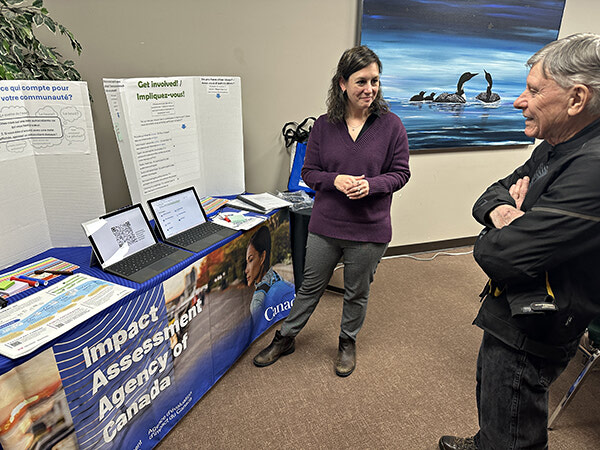
IAAC, CNSC invite public to review, comment on summary of Initial Project Description for NWMO’s proposed DGR project
Tim Brody - Editor
The Impact Assessment Agency of Canada (IAAC) and the Canadian Nuclear Safety Commission (the CNSC) are inviting the public to review the summary of the Initial Project Description for the Nuclear Waste Management Organization’s (the NWMO) proposed new underground deep geological repository (DGR) system and provide comments on the proposed project to contain and isolate used nuclear fuel.
This, both agencies say, will help them prepare a summary of issues for the proponent.
The proposed DGR would be located 43 km northwest of Ignace.
Representatives from IAAC and CNSC were in Sioux Lookout on Jan. 21 at Fresh Market Foods, the Sioux Lookout Public Library and in the evening at the Forest Inn and Conference Centre to share information about the project and ask people to comment on the Initial Project Description.
Funding is also available to help participate in the impact assessment process for this project.
Members of the public are invited to visit the project homepage on the Canadian Impact Assessment Registry (canada.ca/ciar), reference number 88774 (https://iaac-aeic.gc.ca/050/evaluations/proj/88774) to:
- Learn more about the project.
Submit your comments online by 11:59 p.m. on February 4, 2026. All comments will be published to the Registry. - Apply for participant funding by February 4, 2026.
- Join an information session to learn more about the project and the integrated impact assessment process.
Printed copies of the summary of the Initial Project Description are available for viewing at:
- Sioux Lookout Municipal Office, 25 5th Avenue, Sioux Lookout, Ontario
- Sioux Lookout Library, 21 5th Avenue, Sioux Lookout, Ontario
- Thunder Bay City Hall, 500 Donald Street East, Thunder Bay, Ontario
IAAC shared on their website, “The Nuclear Waste Management Organization (the NWMO) is proposing a new underground deep geological repository system designed to safely contain and isolate used nuclear fuel. Wabigoon Lake Ojibway Nation (WLON) and the Township of Ignace have been selected as the host communities for the proposed project, which is located 21 kilometres southeast of the WLON and 43 kilometres northwest of the Town of Ignace, Ontario along Highway 17. As proposed, the Deep Geological Repository (DGR) for Canada’s Used Nuclear Fuel Project would provide permanent storage for approximately 5.9 million bundles of used nuclear fuel. The project is expected to span approximately 160 years, encompassing site preparation, construction, operation and closure monitoring. The project assessment is being conducted in collaboration with the Canadian Nuclear Safety Commission.”
On Jan. 5 the NWMO posted on their website, “On Jan. 5, 2026, the Nuclear Waste Management Organization (NWMO) announced the Initial Project Description for the proposed Deep Geological Repository for Canada’s Used Nuclear Fuel Project is now posted to the Impact Assessment Agency of Canada website.
“This step marks the beginning of an in-depth regulatory process and a notable milestone for our work as the project moves from planning to independent review. It also brings another opportunity for host communities, potentially impacted Indigenous groups and the public to share their perspectives and contribute to shaping Canada’s plan to safely contain and isolate used nuclear fuel over the long term.
“In November 2024, following a rigorous community-driven process, Wabigoon Lake Ojibway Nation (WLON) and the Township of Ignace agreed to enter the regulatory decision-making phase as potential host communities for the repository.
“Now, the project advances to the next step with the submission of the Initial Project Description. This document is foundational as it details the deep geological repository’s purpose, need and expected benefits, and it explains how the project will be implemented in a manner that protects people and the environment. It also provides a preliminary assessment of potential impacts and describes measures to avoid or mitigate them.
“The posting of the Initial Project Description to the Impact Assessment Agency of Canada registry formally initiates the federal impact assessment and licensing processes and provides the basis for sustained community engagement.”
“For the NWMO, submitting the Initial Project Description represents more than a regulatory requirement,” commented Allan Webster, NWMO Vice-President of Regulatory Approvals. “It is a shared starting point that brings together engineering, environmental, Indigenous Knowledge and community perspectives to guide how the project moves forward through impact assessment, licensing, design optimization, construction and operations.”
In a Jan. 7 media release, We the Nuclear Free North, shared, “We the Nuclear Free North (WTNFN) has noted fundamental flaws in the Nuclear Waste Management Organization’s (NWMO’s) Initial Project Description for its planned deep geological repository for all of Canada’s nuclear fuel waste.
“A key concern is that the NWMO has omitted the long-distance transportation of the waste from its project description, despite the Impact Assessment Act’s requirement that activities integral to a project be included in its assessment.
“There’s no nuclear waste burial project if there’s no nuclear waste transported,” said Brennain Lloyd, Project Coordinator for Northwatch. “Transportation is part and parcel of the project – the NWMO has represented it that way for two decades. Transportation must be assessed as part of this project review.”
“The NWMO’s Initial Project Description document deals rather lightly with the project, despite its length,” commented Wendy O’Connor, a volunteer with Nuclear Free Thunder Bay and We the Nuclear Free North. “I expected to see greater detail on the project’s safety case, and more information about the waste repackaging facility that will be on the surface releasing radioactive contaminants to water, land and air. I rely on the Impact Assessment Agency to demand more detail on these from the NWMO, and my comments will reflect that.”
NOCANDU (Northern Ontario Coalition Against Nuclear Dumping Underground) noted the risk of earthquakes being a concern.
In a Sept. 2022 document they shared, “There is a cluster of frequent seismic events and activity along the route of the populated areas from Thunder Bay to Kenora including Ignace, Wabigoon, Dryden and Sioux Lookout.”
NOCANDU cites an article in the Feb. 14,1984 Sioux Lookout Daily Bulletin about an earthquake measuring 3.9 on the Richer Scale impacting the Sioux Lookout area.
“Clearly there is an active earthquake zone throughout the area which the NWMO has failed to acknowledge in their assertions. This is a serious and fatal technical flaw in the work of the NWMO,” NOCANDU states.
In April of 2023 NOCANDU representatives Greg Hlady and Remi Lorteau sent a letter to the Minister of the Environment and Climate Change requesting a Regional Impact Assessment covering the full extent of the Nelson Watershed relating to the NWMO’s proposed DGR project.
Their letter stated that, “There are serious concerns with the manner in which the NWMO is attempting to implement a siting of a deep geological repository for Canada’s high level nuclear waste.”
They went on to state in their letter, “Hundreds of thousands of people stand to be affected by radiological contamination if the Nelson watershed becomes contaminated.”
Hlady and Lorteau also allege in their letter, “The Regulator, the CNSC, is complicit and ineffective in steering the management of nuclear waste in Canada toward a technically, socially, and ethically managed solution that meets stated public- interest objectives without creating unnecessary risks or proliferating nuclear accidents or terrorism impacts.”
IAAC, in collaboration with CNSC further shared with The Bulletin about the commenting periods and public participation:
• The planning phase has a legislated timeline of 180 days which is generally broken into two parts, the first being 80 days and the second 100 days.
· During the first 80 days, there is a 30-day public comment period, followed by 10 days for IAAC and the CNSC to prepare the Summary of Issues. The proponent then has 30 days to prepare the response to the Summary of Issues, after which IAAC and the CNSC have 10 days to prepare the documents required to support the decision on whether a further assessment under the Impact Assessment Act will be required.
· During the second 100 days, there is a second 30-day comment period on the draft Tailored Impact Statement Guidelines and Public Participation Plan. This is followed by up to 70 days for IAAC and the CNSC to make revisions based on comments received and issue the final guidelines and planning documents, marking the end of the planning phase.
IAAC, in collaboration with CNSC further shared with The Bulletin:
• “The Deep Geological Repository (DGR) for Canada’s Used Nuclear Fuel Project (DGR project) is expected to be subject to an integrated assessment. The Impact Assessment Agency of Canada (IAAC) and the Canadian Nuclear Safety Commission (CNSC) are working together on the integrated assessment to achieve the goal of “one project, one review”.
• The integrated assessment process involves IAAC and the CNSC collaborating on the review and evaluation of key documents from the proponent to meet the requirements of the Impact Assessment Act and the Nuclear Safety and Control Act. They also collaborate on Crown consultation, meeting the Duty to Consult, and obtaining public input.
• Should an integrated assessment be required, IAAC and the CNSC will focus the assessment on potential adverse effects to areas of federal jurisdiction, as informed by comments received from participants.
• Integrated assessments provide a robust, independent evaluation of the potential impacts of proposed projects and include meaningful consultation and engagement with Indigenous Peoples and the public. The process includes consultation with potentially affected Indigenous Nations and communities, whose input and, where shared, Indigenous Knowledge, is valued and incorporated along with Western science to identify potential impacts and ways to reduce those impacts.
The agencies further shared:
• Currently, there is a 30-day comment period open on the summary of the Initial Project Description, ending on February 4, 2026. Comments should be based on local, regional, or Indigenous Knowledge of the site or surrounding environment, or provide any other relevant information that may support the conduct of this assessment. Comments received will support IAAC and the CNSC in the preparation of a summary of issues that will be sent to the proponent and help shape how the overall integrated assessment will be carried out.
• The Impact Assessment Act requires that the public have meaningful opportunities to participate throughout the federal impact assessment process. The next comment period will be inviting comments on the draft Integrated Tailored Impact Statement Guidelines. There will be additional opportunities announced on the Canadian Impact Assessment Registry for public participation throughout the integrated assessment process where issues, perspectives and interests related to the DGR project can be shared. To stay up to date on the project, subscribe to the registry notification system.

Canadian Airways Norseman in front of the town beach....