

Community comes together in spirit of truth and reconciliation
WARNING: This story contains details some readers may find distressing.
Tim Brody - Editor
Sioux Lookout residents, businesses, organizations, and schools reflecting on Truth and Reconciliation throughout the week last week leading up to the National Day for Truth and Reconciliation on Sept. 30.
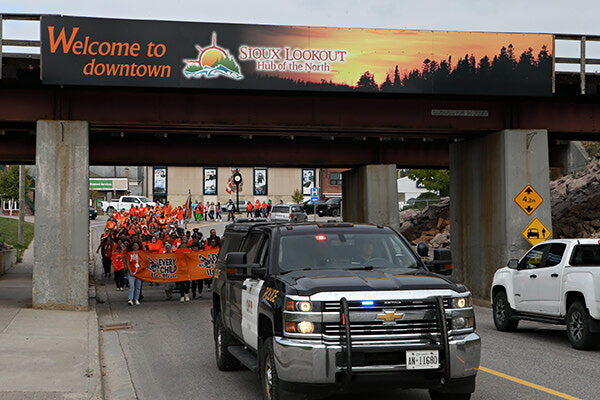
Sioux Lookout First Nations Health Authority held a week of activities in commemoration, which included a Truth and Reconciliation Remembrance Walk on Sept. 27.
The large group of participants met at the Sioux Lookout OPP station, marching through the downtown core to Farlinger Park (Town Beach).
One of the participants in the walk was Garnet Angeconeb, a Lac Seul First Nation band member and survivor of Pelican Lake Indian Residential School.
Angeconeb said it was wonderful to see so many people out in the true spirit of reconciliation, “Really good to see all of the orange, people wearing orange, it’s such a good colour and it’s really powerful in its message, so I’m really grateful to be here.”
Angeconeb attended residential school for six years along with his siblings. His mother and father had also attended the same residential school.
“The past is important. We acknowledge the past. We acknowledge where we are at today. When I look at all of you out there today, we know where we are heading today, into the future in the spirit of reconciliation. I think that’s such a big difference from when the residential schools were in operation,” he shared.
“A march like this or a walk like this would have never happened back 60 years ago. Walking along with the Ontario Provincial Police in a peaceful way and in a good way, that’s a really good start in achieving the spirit of reconciliation,” Angeconeb said.
“Coming along Front Street, you come by the old Sioux Hotel… those were the places where many of us used to hide our pain, mask our pain through alcohol. It wasn’t great… today we still have the same kind of issues, but different in many ways, and so it is really important that we never forget those brothers and sisters who are still hurting, that we never leave them behind,” he shared.
SLFNHA CEO and President Sonia Isaac-Mann shared with The Bulletin about the week of activities they hosted, “As an Indigenous organization with a large presence in town, Sioux Lookout First Nations Health Authority felt it was important to do our part to bring awareness and attention to Truth and Reconciliation. We also wanted to honour the survivors of residential schools and the memory of the children that never returned from those institutions.”
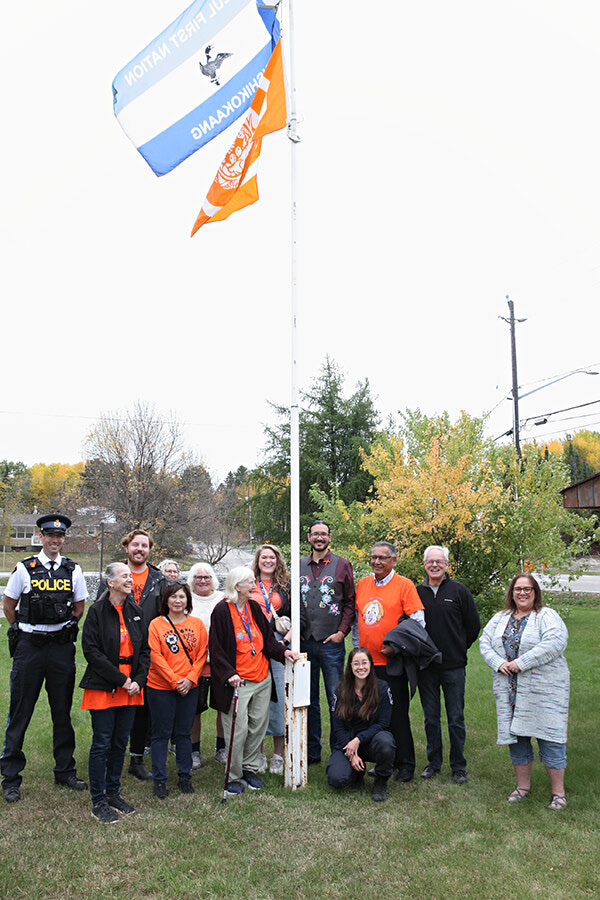
On the morning of Sept. 29, Lac Seul First Nation Chief Clifford Bull and Sioux Lookout Mayor Doug Lawrance raised the survivors flag at the Travel Information Centre.
“Today we acknowledge the National Day for Truth and Reconciliation, a day to remember that every child matters. Our missing children matter. As students and youth, you are here with us and you matter,” Chief Bull shared. “Today, the National Day for Truth and Reconciliation is (about) honour and commemoration, honouring and acknowledging the children who never returned home, the survivors of residential schools, their families and communities. It is a day to observe and remember the painful history of what school was like for the missing children and the survivors who are still with us today. Today is also the day we wear orange. The orange shirts we wear are to remember the missing children who never made it home from residential schools and hospitals.”
Bull continued, “The orange shirt is a symbol to remember what the residential school system took from our people – culture, or way of life, how we used to survive, hunting, fishing, and trapping. Took away the language. Our people were not allowed to speak their language. Children were punished for speaking their language. It took away parenting. Children as young as three-years-old were taken away from their parents, the structure of families was broken. Residential school children were not taught love. Children had to learn new ways of self-preservation to protect themselves. It also took away freedom. Children lost their freedom when they went to residential school. The residential schools were like prisons. The children could not go home every day like today. They lost self-esteem. The residential schools did not make children happy. Children were punished while learning. Lost their identity, children were taught that who they were was not the way they were supposed to be. Children were taught their way of life and everything they knew was wrong. Residential school was not a happy place. Those in charge attempted to destroy the culture, language, parenting, freedoms, self-esteem, and identities of our people. We are thankful we do not have schools today that take young children away from their families and communities.”
Mayor Lawrance commented, “Today of all days we can acknowledge that we are here on the traditional territory of the Lac Seul First Nation and we are proud to fly the flag which Chief Bull has given us of the Lac Seul First Nation.”
Lawrance shared, “It’s probably fair to say that Sioux Lookout’s uniqueness is centered on our role as Hub of the North and our relationship with First Nations people and First Nations communities and also our relationship with truth and reconciliation. We honour the day of Truth and Reconciliation with a flag raising, but I think that Sioux Lookout for many years has acknowledged the truth. We see the ongoing impact of the truth on the people and as a municipality, we’ve undertaken in our own small way, measures of reconciliation over the years. These measures range from gestures, to advocacy, to engagement and action. All of these gestures are taken with the hope of improving lives.”
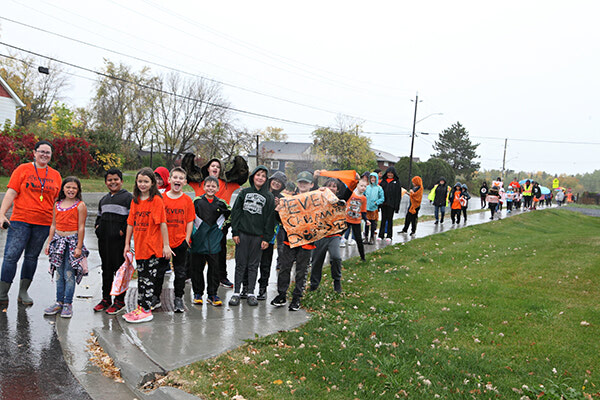
Children also learned about Canada’s residential school legacy at Sacred Heart school on Sept. 29, donning orange shirts and undertaking a Truth and Reconciliation walk.
Sacred Heart School Vice-Principal Jennifer Pugh said, “Today at Sacred Heart School, staff and students participated in a variety of activities for National Truth and Reconciliation Day. We began the day with an informative assembly, planned and led by our Student Leadership Club in orange shirts. Student leaders then rotated through classrooms for a t-shirt design art contest, Truth and Reconciliation read alouds, rock painting, and poster making, culminating with a school-wide walk in the afternoon. Although today is an important day, we recognize and work toward Truth and Reconciliation each and every day.”
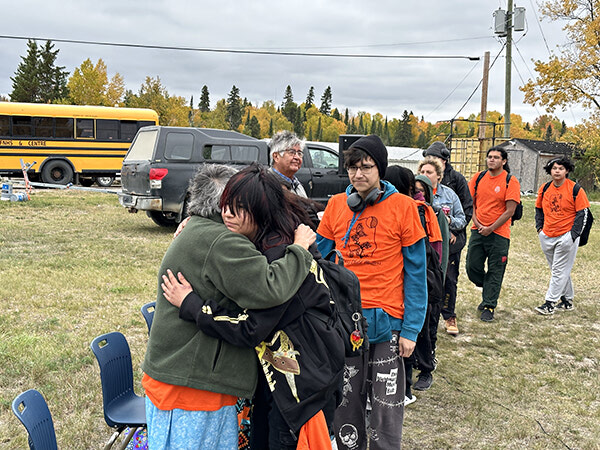
At Pelican Falls First Nations High School students listened attentatively to the words of four elders from Lac Seul First Nation who shared with them about Pelican Falls Indian Residential School legacy, a school which was situated upon the school’s grounds.
Victor Lyon, Cultural Coordinator at Pelican Falls First Nations High School said of inviting the elders to speak, “I tried to give them a chance to tell the history of this place... A lot of the students don’t know those things.”
“It was mainly focused on educating them about what today was and what this place was before and try to speak about the resilience of our ancestors,” he added.
Commenting on the experience he shared, “I was totally blown away. It was really amazing, especially with eagle showing up in the tree just when one of the survivors started talking… It was very powerful the things that they disclosed and talked about and emotional too. The students were really respectful and attentative.”
One of the four elders who addressed PFFNHS students was elder Tom Chisel, a traditional healer with SLFNHA who attended Pelican Lake Indian Residential School for six years, starting when he was six years old.
“For me, I was asked to come out and share a bit about my experience here. It’s certainly important for the young people to know what happened to the children during those years when residential schools existed. There was a lot of pain those children experienced and the inter-generational effects of the residential school, each one that went to residential school had to be affected negatively and that gets passed on through the generations. So young people today, helped them to understand why their parents are the way they are or their grandparents are the way they are or their great-grandparents. We helped them understand what happened to them, how it affected them.”
Chisel went on to share, “I know my father was affected by the sexual abuse that he experienced and I found out what happened and then I began to understand and I was no longer angry with him. That’s why it’s important to share these stories, but also the message I gave them was to let them know that it’s okay to learn your language, to keep your language, to follow your spirituality, the spirituality of our people. That’s important, that was ours and there was nothing ever wrong with it.”
Commenting on the National Day for Truth and Reconciliation, Chisel imparted, “I think it’s important to have it of course, Canadians were never told of these things, the governments and the churches tried to hide it. It was only because survivors were willing to tell their stories, because they started to speak about their experiences, that’s the reason why the government had to do something, otherwise they would have tried to push it under the rug and even today you still have certain government representatives who deny that anything happened.”
IRS Survivors, their families, and anyone requiring emotional support or assistance can contact:
IRS Survivors Society at 1-800-721-0066 (toll-free)
IRS Crisis Line at 1-866-925-4419
NAN Hope at 1-844-NAN-HOPE (626-4673)
Northwestern Ontario Pride organizations are calling for an urgent meeting with Kenora MP Eric Melillo...